The land and lakes of Finland
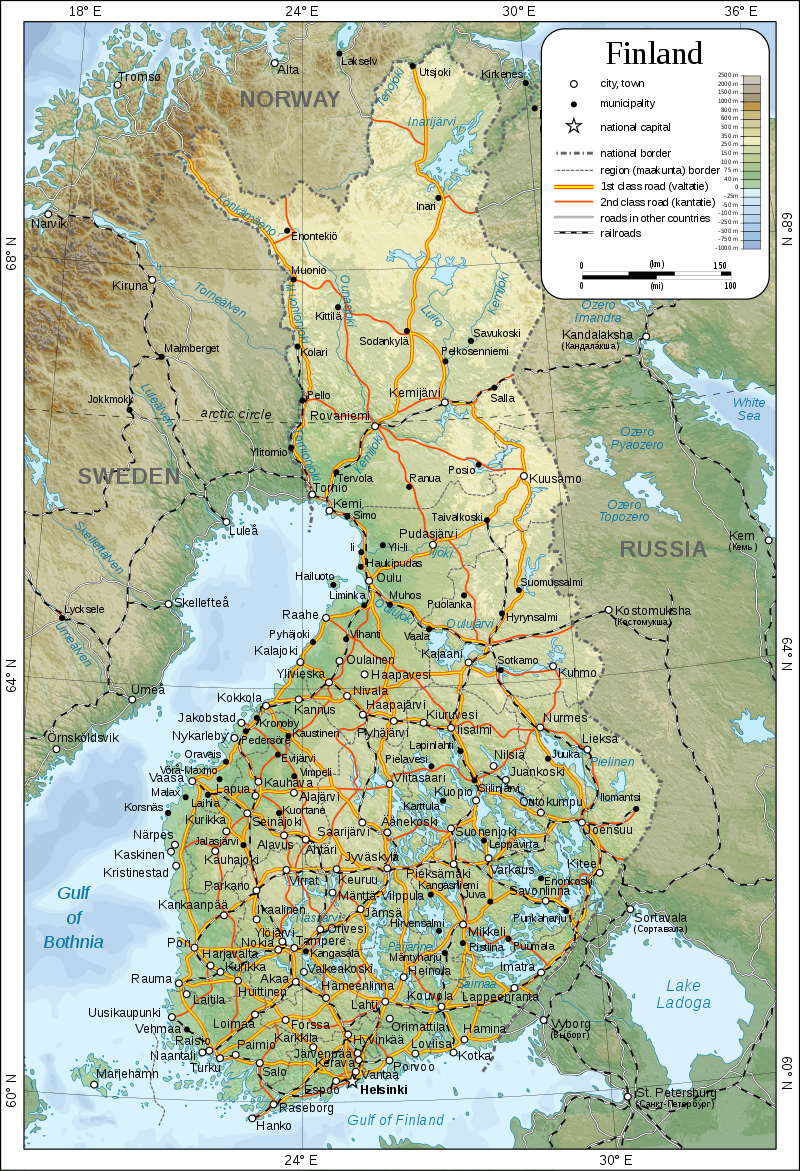
Lying approximately between latitudes 60° and 70° N, and longitudes 20° and 32° E, Finland is one of the world's northernmost countries. Of world capitals, only Reykjavík lies more to the north than Helsinki. The distance from the southernmost point – Hanko in Uusimaa – to the northernmost – Nuorgam in Lapland – is 1,160 kilometres (720 mi).
Finland has about 168,000 lakes (of area larger than 500 m2 or 0.12 acres) and 179,000 islands. Its largest lake, Saimaa, is the fourth largest in Europe. The Finnish Lakeland is the area with the most lakes in the country; many of the major cities in the area, most notably Tampere, Jyväskylä and Kuopio, are located in the immediate vicinity of the large lakes. The greatest concentration of islands is found in the southwest, in the Archipelago Sea between continental Finland and the main island of Åland.
Much of the geography of Finland is a result of the Ice Age. The glaciers were thicker and lasted longer in Fennoscandia compared with the rest of Europe. Their eroding effects have left the Finnish landscape mostly flat with few hills and fewer mountains. Its highest point, the Halti at 1,324 metres (4,344 ft), is found in the extreme north of Lapland at the border between Finland and Norway. The highest mountain whose peak is entirely in Finland is Ridnitšohkka at 1,316 m (4,318 ft), directly adjacent to Halti.
The retreating glaciers have left the land with morainic deposits in formations of eskers. These are ridges of stratified gravel and sand, running northwest to southeast, where the ancient edge of the glacier once lay. Among the biggest of these are the three Salpausselkä ridges that run across southern Finland.
Having been compressed under the enormous weight of the glaciers, terrain in Finland is rising due to the post-glacial rebound. The effect is strongest around the Gulf of Bothnia, where land steadily rises about 1 cm (0.4 in) a year. As a result, the old sea bottom turns little by little into dry land: the surface area of the country is expanding by about 7 square kilometres (2.7 sq mi) annually. Relatively speaking, Finland is rising from the sea.
The landscape is covered mostly by coniferous taiga forests and fens, with little cultivated land. Of the total area 10% is lakes, rivers and ponds, and 78% forest. The forest consists of pine, spruce, birch, and other species. Finland is the largest producer of wood in Europe and among the largest in the world. The most common type of rock is granite. It is a ubiquitous part of the scenery, visible wherever there is no soil cover. Moraine or till is the most common type of soil, covered by a thin layer of humus of biological origin. Podzol profile development is seen in most forest soils except where drainage is poor. Gleysols and peat bogs occupy poorly drained areas.

Biodiversity
Phytogeographically, Finland is shared between the Arctic, central European, and northern European provinces of the Circumboreal Region within the Boreal Kingdom. According to the WWF, the territory of Finland can be subdivided into three ecoregions: the Scandinavian and Russian taiga, Sarmatic mixed forests, and Scandinavian Montane Birch forest and grasslands. Taiga covers most of Finland from northern regions of southern provinces to the north of Lapland. On the southwestern coast, south of the Helsinki-Rauma line, forests are characterized by mixed forests, that are more typical in the Baltic region. In the extreme north of Finland, near the tree line and Arctic Ocean, Montane Birch forests are common. Finland had a 2018 Forest Landscape Integrity Index mean score of 5.08/10, ranking it 109th globally out of 172 countries.

Similarly, Finland has a diverse and extensive range of fauna. There are at least sixty native mammalian species, 248 breeding bird species, over 70 fish species, and 11 reptile and frog species present today, many migrating from neighbouring countries thousands of years ago. Large and widely recognized wildlife mammals found in Finland are the brown bear, grey wolf, wolverine, and elk. The brown bear, which is also nicknamed as the "king of the forest" by the Finns, is the country's official national animal, which also occur on the coat of arms of the Satakunta region is a crown-headed black bear carrying a sword, possibly referring to the regional capital city of Pori, whose Swedish name Björneborg and the Latin name Arctopolis literally means "bear city" or "bear fortress". Three of the more striking birds are the whooper swan, a large European swan and the national bird of Finland; the Western capercaillie, a large, black-plumaged member of the grouse family; and the Eurasian eagle-owl. The latter is considered an indicator of old-growth forest connectivity, and has been declining because of landscape fragmentation. Around 24,000 species of Insects are prevalent in Finland some of the most common being hornets with tribes of beetles such as the Onciderini also being common. The most common breeding birds are the willow warbler, common chaffinch, and redwing. Of some seventy species of freshwater fish, the northern pike, perch, and others are plentiful. Atlantic salmon remains the favourite of fly rod enthusiasts.
The endangered Saimaa ringed seal (Pusa hispida saimensis), one of only three lake seal species in the world, exists only in the Saimaa lake system of southeastern Finland, down to only 390 seals today. Ever since the species was protected in 1955, it has become the emblem of the Finnish Association for Nature Conservation. The Saimaa ringed seal lives nowadays mainly in two Finnish national parks, Kolovesi and Linnansaari, but strays have been seen in a much larger area, including near Savonlinna's town centre.
Climate
The main factor influencing Finland's climate is the country's geographical position between the 60th and 70th northern parallels in the Eurasian continent's coastal zone. In the Köppen climate classification, the whole of Finland lies in the boreal zone, characterized by warm summers and freezing winters. Within the country, the temperateness varies considerably between the southern coastal regions and the extreme north, showing characteristics of both a maritime and a continental climate. Finland is near enough to the Atlantic Ocean to be continuously warmed by the Gulf Stream. The Gulf Stream combines with the moderating effects of the Baltic Sea and numerous inland lakes to explain the unusually warm climate compared with other regions that share the same latitude, such as Alaska, Siberia, and southern Greenland.
Winters in southern Finland (when mean daily temperature remains below 0 °C or 32 °F) are usually about 100 days long, and in the inland the snow typically covers the land from about late November to April, and on the coastal areas such as Helsinki, snow often covers the land from late December to late March. Even in the south, the harshest winter nights can see the temperatures fall to −30 °C (−22 °F) although on coastal areas like Helsinki, temperatures below −30 °C (−22 °F) are rare. Climatic summers (when mean daily temperature remains above 10 °C or 50 °F) in southern Finland last from about late May to mid-September, and in the inland, the warmest days of July can reach over 35 °C (95 °F). Although most of Finland lies on the taiga belt, the southernmost coastal regions are sometimes classified as hemiboreal.
In northern Finland, particularly in Lapland, the winters are long and cold, while the summers are relatively warm but short. The most severe winter days in Lapland can see the temperature fall down to −45 °C (−49 °F). The winter of the north lasts for about 200 days with permanent snow cover from about mid-October to early May. Summers in the north are quite short, only two to three months, but can still see maximum daily temperatures above 25 °C (77 °F) during heat waves. No part of Finland has Arctic tundra, but Alpine tundra can be found at the fells Lapland.
The Finnish climate is suitable for cereal farming only in the southernmost regions, while the northern regions are suitable for animal husbandry.
A quarter of Finland's territory lies within the Arctic Circle and the midnight sun can be experienced for more days the farther north one travels. At Finland's northernmost point, the sun does not set for 73 consecutive days during summer, and does not rise at all for 51 days during winter.
Counties
Finland consists of 19 counties, called maakunta in Finnish and landskap in Swedish: Lapland, North Ostrobothnia, Kainuu, North Karelia, North Savo, South Savo, South Ostrobothnia, Central Ostrobothnia, Ostrobothnia, Pirkanmaa, Central Finland, Satakunta, Southwest Finland, South Karelia, Päijät-Häme, Kanta-Häme, Uusimaa, Kymenlaakso and Åland. The counties are governed by regional councils which serve as forums of cooperation for the municipalities of a county. The main tasks of the counties are regional planning and development of enterprise and education. In addition, the public health services are usually organized on the basis of counties. Currently, the only county where a popular election is held for the council is Kainuu. Other regional councils are elected by municipal councils, each municipality sending representatives in proportion to its population.
In addition to inter-municipal cooperation, which is the responsibility of regional councils, each county has a state Employment and Economic Development Centre which is responsible for the local administration of labour, agriculture, fisheries, forestry, and entrepreneurial affairs. The Finnish Defence Forces regional offices are responsible for the regional defence preparations and for the administration of conscription within the county.
Counties represent dialectal, cultural, and economic variations better than the former provinces, which were purely administrative divisions of the central government. Historically, counties are divisions of historical provinces of Finland, areas which represent dialects and culture more accurately.
Six Regional State Administrative Agencies were created by the state of Finland in 2010, each of them responsible for one of the counties called alue in Finnish and region in Swedish; in addition, Åland was designated a seventh county. These take over some of the tasks of the earlier Provinces of Finland (lääni/län), which were abolished.
Comments
Post a Comment